CONTACT US:

469 Medical Drive Suite 200 Bountiful, Utah (801) 292-5812
Showing posts with label Bountiful Utah. Show all posts

Friday, March 3, 2017


Gum Recession: Causes & Treatment

Many people suffer from gum recession. It is more common than you may think. Most of our patients realize they have a problem with recession when they have symptoms including: sensitivity to hot and cold, sensitivity to sweets, and even tenderness when brushing. Luckily, there are treatments to help gum recession, and ways to improve your oral hygiene routine to prevent gum recession in the first place, or at the very least, keep it from getting worse.

Gum Recession Causes & Treatments:
-          Brushing too hard or used a hard-bristled toothbrush: Changing the way you are holding your toothbrush and using a soft or extra-soft bristled toothbrush can help keep gum recession at bay.

-          Periodontal Disease: Being properly diagnosed and treated for periodontal disease can help stop recession in its tracks. Unfortunately, it won’t repair what has already been lost, but can prevent it from getting worse.


-          Trauma to gum tissues: Trauma from sharp foots, playing sports, or the constant use of toothpicks can initiate recession.

-          Ill-fitting partial denture: A poor fitting denture can add unwanted pressure to the gum tissue, leading to recession.

-          Genetics- some people have thin or weak gum tissue: Genetics play a role in overall oral health, including recession.

-          Prominent tooth roots or crooked teeth – can push gums out of place: Orthodontics can help move tooth roots into the proper positions and prevent gum recession.

-          Smoking or other tobacco product use: Any type of tobacco product use is detrimental to oral health. Tobacco use and periodontal disease go hand in hand. Avoiding or discontinuing the use of tobacco can stop recession in its tracks.


If gum recession has progressed so far that gum grafting if necessary, seeing a qualified dentist to have the procedure completed is essential. Dr. Davis has performed many successful gum grafting surgeries and takes pride in using the highest quality products for the best results. 

Source: http://www.ada.org/~/media/ADA/Publications/Files/ADA_PatientSmart_Gum_Recession.ashx

Monday, January 9, 2017

Top 5 Reasons 6 Month Dental Appointments Are Important

  • Plaque and Tarter Removal: A dental hygienist does a much better cleaning job than we can perform at home. Using specialized instruments, he/she is able to remove hardened plaque (tarter & buildup) that can be detrimental to our oral health. 

  • Oral Cancer Screenings: The dentist and/or the dental hygienist will perform an oral cancer screening. They will also routinely take a full mouth x-ray (panoramic x-ray) which is the only imaging currently available that allows dentists to detect oral cancer or other abnormalities. This is extremely important because if not detected early on, oral cancer can be devastating and even cause death.

  • Irregular Cleanings Can Lead to Bone Loss: Irregular cleanings allow tarter and buildup to get down below the gums, and if left untreated leads to bone loss. Bone loss leads to tooth loss. Tooth replacement options can be costly, so it is best to stay on a regular schedule with your dentist. 

  • Detection of Other Problems: Your dentist may be able to identify other health problems that present themselves through the mouth. Examples include; 

Eating Disorders- can be seen through symptoms or dry mouth and 
acid erosion along the tooth's enamel. 

Heart Disease- inflamed, bleeding gums and loose teeth could be 
signs of heart complications. Lack of proper hygiene can also
lead to heart problems because of the bacteria that is present.

Osteoporosis- receding gums and loose teeth are strong indicators 
an underlying bone issue. It won't necessarily show itself through
the teeth, but the bone supporting the teeth.


  • Full Mouth Exam: The doctor will thoroughly review x-rays, and also perform an intra-oral exam to make sure there are no abnormalities in the tooth structure. He/She will determine the best form of treatment if any treatment is necessary. These routine examinations are essential to maintaining good oral health and preventing potential problems. 


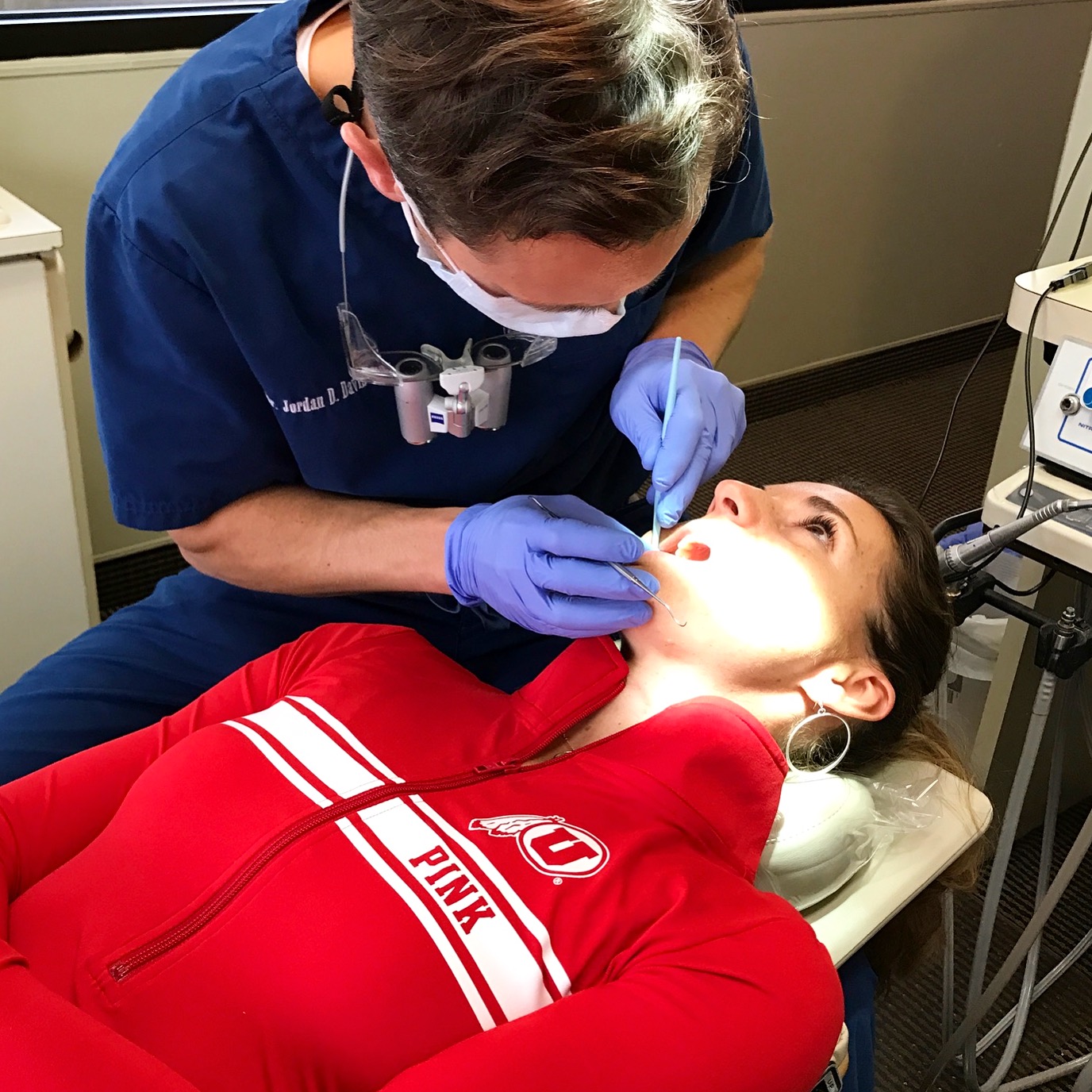
Dr. Davis performing a thorough exam.


Here at Davis Dental we strive to give our patients the best care possible! We would love to give you an amazing dental experience! 

For more information or to make an appointment, contact Davis Dental at: 
(801)292-5812 or visit our website davisdentalutah.com


Tuesday, September 27, 2016

 7 Healthy Foods For Your Teeth

The foods that you consume play a major role in your overall dental health. People who eat foods with a high sugar content are more prone to dental caries/cavities. Here is a list of the top 7 foods that are good for your teeth. 


  • Cheese- Not processed cheese, but block cheese or string cheese are great options. The enzymes in cheese can help to balance the pH levels in the mouth and increase saliva production. This helps to lower your risk for tooth decay. Cheese also contains calcium and protein which strengthens tooth enamel. 


  • Yogurt- Yogurt also has protein and calcium to strengthen enamel. It has probiotics, or good bacteria that can rid your gums of caries causing bacteria. The best yogurt choice is a plain yogurt because the flavored varieties have added sugar. 


  • Carrots- Carrots are crunchy and full of fiber. Eating carrots increases saliva production which helps to "rinse" the teeth and prevent cavities.

    • Leafy Greens- They are full of calcium which helps tooth enamel, but also contain folic acid which can possibly improve gum disease in pregnant women. If you don't enjoy leafy greens by themselves or in a salad, you could try sneaking them into other foods you do enjoy. Such as smoothies, or on a pizza. 


    • Apples- Apples produce saliva in the mouth which helps clear away food debris, but the texture of an apple is similar to that of brushing your teeth. It definitely doesn't replace brushing with a toothbrush and toothpaste, but is a good way to clean your teeth until you can brush them. 


    • Celery- Celery is similar to apples and carrots. It is great for increasing saliva production and helping to rid your mouth of that pesky food debris. If you don't love plain celery, try it with some peanut butter to change it up. 


      • Almonds- They are high in fiber and protein but very low in sugar. This helps to strengthen tooth enamel and serves as a great and filling snack. Almonds are great on their own or tossed into a salad. 


      Here at Davis Dental, we want to help you find easy ways to improve your oral health. We hope these simple and healthy foods will get you headed in the right direction! 

      For more information or to make an appointment, contact us at: (801)292-5812 or visit our website at davisdentalutah.com


      Information for this post was gathered from colgate.com pictures were obtained from google.

      Tuesday, August 30, 2016

      Importance of a Mouth Guard


      Many kids and teenagers don't realize the importance of using a mouth guard while participating in sports. In their minds, "mouth guards are stupid", right? Mouth guards aren't only important for young children or teens, they are just as important for adults. Here are some reasons mouth guards are essential. 

      • It protects your teeth, cheeks, mouth, tongue, and jaw from injury. Although a mouth guard is made of plastic or laminate materials, it can prevent over 200,000 oral injuries every year. 

      • Injuries to the mouth or jaw can be expensive and very painful. Possible injuries include; broken or chipped teeth, biting the cheeks or lips, root damage, fractured jaw, and concussions. Many of these can be prevented by the use of a mouth guard. 

      • Mouth guards don't have to empty the bank account. There are essentially three options when it comes to mouth guards. 
      1.  Stock Mouth Guards. These are a "one size fits all". The biggest issue we find with this type of guard is that it doesn't fit well for everyone, and is not made to be adjusted to fit. Patients have complained that the stock guards are extremely bulky and tend to make hard or heavy breathing during game time difficult. They are very inexpensive, and can be picked up at any sporting goods store. 
      2.  Boil and Bite Mouth Guards. These are a step up from the stock guards we talked about. With this type of guard, it requires you to boil the plastic material for a certain amount of time, then bite into it to give it a more customized fit. They are also inexpensive and can be molded in the comfort of your own home. The down side to this type of guard, is it also doesn't fit every person correctly. It tends to be bulky in the mouth, but is more comfortable to wear than a stock mouth guard.        
      3.  Custom Fit Mouth Guards. This is a guard that we make in our office for you. We take dental impressions of your teeth, pour up this impression in dental stone, and then mold the plastic material to it. This type of mouth guard is much more comfortable to wear and will also protect your overall mouth better because it is molded specifically for you. 


      Here at Davis Dental, we want to help you protect your smile for many years to come! Come in and see us for a custom mouth guard or for any of your other dental needs. We would love to give you the best dental experience you've ever had. We look forward to meeting you! 
      Contact us at: (801)292-5812 or visit our website at: www.davisdentalutah.com


      Information gathered from colgate.com

      Tuesday, July 12, 2016

      What Our Patients Are Saying About Davis Dental


      "I am always extremely pleased with my visits to Dr. Davis. He has a wonderful team; I am always warmly greeted by the front desk staff and immediately feel “at home” in a very comfortable atmosphere. Dr. Davis is always very thorough and professional; He and his outstanding staff is patient and take all the time needed to discuss the dental issues and what are the options for treatment. I feel that my care is in very capable hands and the office utilizes the highest technology. Everything a patient is looking for is present in Dr. Davis office. A super dental office where I feel I receive the best of care." - Christiane F. 

      "My experience with Dr. Jordan Davis, DDS and staff was authentically compassionate, and professional. The lovely receptionist (Janet) and the hygienist (Tandem) were enjoyable and efficient making me feel completely comfortable as they explained and educated me in the working process. I felt Dr. Jordan Davis was extremely competent and dedicated to providing the latest technology for my dental health and personal needs. I was completely satisfied with the whole experience and felt like I walked away with peace of mind, an uncommon experience in my dental history." - Colleen W. 

      "Dr. Davis and his team were so kind to me! I had to have all 4 of my wisdom teeth taken out and due to being pregnant they could not sedate me. I was very nervous and they were very patient and kept me calm. They continually monitored my heart rate and blood pressure, and made sure that I was as comfortable as possible. They were extremely reasonable with my payment options and helped me in all ways possible. I would recommend Dr. Davis to any and all who are looking for a fantastic experience at the dentist." - Maddison D. 

      "Dr. Davis and his team really know their "stuff!" Their professionalism and knowing how to do their job is equal to (or maybe even surpassed by) their friendly and caring attitude. They want everything right for you. They may have one or two other patients being seen while I am there, but I have always felt like I was their primary concern. That's how they run the office - and that's good business." - Lamar H. 

      "I have had quite a few procedures with Dr. Davis from simple cleaning and x-Rays to pretty complex procedures with sedation. Every time, he and his staff go above and beyond to make sure my questions are answered and I'm comfortable with the process. To say everyone is great in this office is an understatement. They really truly care! There are very few appointments that I would drive 40 miles roundtrip to but for Dr.Davis and his wonderful staff...I do and will continue to do...as long as I have my teeth :)" - Kande S. 

      We love our patients and take pride in giving them the best dental treatment possible. We look forward to doing the same for you! 

      To learn more about Davis Dental you can visit our website at: www.davisdentalutah.com

      For questions or to make an appointment you can reach us at: (801)292-5812


      Tuesday, June 28, 2016

      George Washington's Dental History

      Have you heard the stories of George Washington's wooden teeth? Did you know that this story is actually a myth? We thought it would be fun to celebrate Independence Day by sharing some interesting facts about George Washington's dental work. 

      "Washington had a long history of illness. In 1751 he wrote of having smallpox and the following year complained that he had a bout of "violent plurise." As a young lieutenant colonel in 1755 serving with General Braddock in the French and Indian War, he suffered "pain in the head" and dysentery. In 1761 when he was twenty-nine and back at Mt. Vernon, he got "breakbone fever," now known as dengue fever, characterized by headache, fever, and severe muscles and joint pain. Over the ensuing years there were attacks of malaria, flu, and rheumatic complaints. Adding to the stress as commander of the continental Army were constant unrelieved toothaches. In some instances, one cannot help but wonder if his teeth might have been the source of the chronic infections he suffered"

      "According to his accounts, he received the standard medical treatments of the day, which included heavy doses of the infamous calomel (mercurous chloride) that can lead to destruction of the teeth. This, combined with what may have been naturally poor teeth, led to dental problems beginning when Washington was twenty-two. Over the next thirty-five years, he would lose all his teeth."

      During this time, tooth powders (since they didn't have toothpaste) were made from pumice, borax, roots and herbs, even burnt bread and tobacco were sometimes used. It was likely that people used a mouth rinse solution that contained herbs or resins of balsam or myrrh, salt, wine, or even vinegar may have been used. 

      Tooth extractions became a yearly occurrence for our founding father. "There were frequent episodes of infected and abscessed teeth, inflamed gums, and finally ill-fitting dentures." George Washington didn't have wooden teeth, but he did have several sets of dentures throughout his life. His first set came shortly after he was inaugurated for his first term as president in 1789. It was made of hippopotamus ivory carved to fit the gums, ivory teeth, and also human teeth. In 1791 he received his second set of dentures and then a third set in 1795. Another large set of dentures was made for him in 1796. "His final set was made in 1798, the year before he died. This set was a swagged gold plate with individual backing for each tooth which was fastened by rivets. The lower denture of this set, along with others, are on display in the Dr. Samuel D. Harris National Museum of Dentistry in Baltimore."

      Here at Davis Dental we are grateful for modern dentistry and to be able to share that with our outstanding patients. Happy Independence Day! 

      To learn more about Davis Dental visit davisdentalutah.com or call us at (801)292-5812

      Information gathered from americanrevolution.org 


      Tuesday, April 5, 2016

      Ten Things To Consider Before Purchasing Dental Insurance


      Are you looking into purchasing a dental benefits/insurance plan? Here is a list of things to consider before you do. 

      1. Will you be able to continue seeing your current dentist? 
      If you have a dentist that you really like, you may want to look into an insurance plan that he or she participates with. If your dentist is not on that list, don't be afraid to ask why your dentist has chosen not to participate. They may have a very good reason. Don't let insurance companies fool you into thinking you can only see a dentist that is on their list. Several companies will help pay even if it is not with a participating doctor. 

      2. Know what is covered in the plan you are researching. 
      Many insurance companies do not cover certain procedures, especially when it comes to preventive treatment. Dental sealants and fluoride are not always covered. Both of these procedures could prevent future decay and save you money in the long run. 

      3. Is the treatment you need determined by you and your dentist?
      If you are having to choose dental treatment based on what your insurance plan will cover, you may not be receiving the treatment that is best for you. You and your dentist should be making the decision together on what treatment is ideal for your overall health. 

      4. What type of dental care is covered?
      Does the plan you are researching cover braces, bridges, crowns, or periodontal disease? What about major treatment such as; dentures, implants, or TMJ disorder? 

      5. What is your coverage maximum?
      Most dental plans cover on average a $1,000-$2,000 maximum per year. This small amount can be greatly diminished after one or two procedures depending on what type of treatment is needed. If you know you need more work than this amount allows, it may not be worth the premiums and remaining out of pocket expense to purchase a dental plan.

      6. What if you need to see a specialist?
      Some plans do not cover specialist visits leaving you with the entire cost out of your own pocket. 

      7. Does the plan cover out of area emergencies?
      Nothing is worse than having a toothache while you are trying to enjoy yourself on vacation. Does your dental insurance take care of these types of visits?

      8. Does the insurance have a waiting period? 
      If you are needing treatment immediately, you are likely going to have to wait 3 months for minor work such as fillings, and one year for major work like bridges and crowns. 

      9. Does the plan have a pre-existing condition clause?
      Some companies will not cover pre-existing conditions such as missing teeth. If you have a missing tooth that needs to be replaced with a bridge or an implant, many times insurance plans will not cover this treatment. 

      10. Do you have an existing crown or bridge that needs to be replaced?
      The majority of insurance plans will not pay for a bridge or crown that needs to be replaced if it has been under 5 years. Some companies won't help pay if it has been less than 7 years. 

      It is important for you as a patient to consider all of these options before opting to purchase a dental insurance plan. 


      Information for this post came from www.investopia.com and www.ada.org

      Tuesday, March 22, 2016

      Opalescence Go is Now Available!!!

      If you are looking for an easy solution to teeth whitening look no further! Our office is now offering Opalescence Go.  Opalescence Go is a professional whitening gel delivered in prefilled, disposable trays.  That means no added cost of custom trays, no gooey impressions, and no lab wait time.

      Benefits of using Opalescence Go:
      • comfortably molds to any patients smile
      • molar to molar coverage
      • 15% hydrogen peroxide formula that only needs to be worn for 15 to 20 minutes
      • contains potassium nitrate that has been shown to help with sensitivity
      • contains fluoride which reduces dental decay
      • formulated with 20% water to keep teeth hydrated during whitening process unlike many other whitening products on the market that dehydrate teeth
      Wondering how whitening products work?

      The whitening process is possible due to the ability of the carbamide peroxide and hydrogen peroxide to freely pass through enamel and dentin to permeate to all parts of the tooth. These peroxides break down into oxygen radicals, which migrate between the enamel prisms, breaking down any colored molecules that result in tooth discoloration. The structure of the tooth is not altered; the internal tooth color is simply made lighter. Whitening agents break down into tiny molecules and move in all directions, so even if the whole tooth is not covered with gel, the entire tooth is whitened.


      All information from this post was obtained from www.ultradent.com.

      For more information on this product or others like this, contact our office at (801)292-5812

      Thursday, November 7, 2013

      DR. DAVIS Joins Two New Professional Organizations

      Dr. Davis joined the and the American Academy of Cosmetic Dentistry


      The AACD Mission
      The American Academy of Cosmetic Dentistry® (AACD) is dedicated to advancing excellence in the art and science of comprehensive cosmetic dentistry and encouraging the highest standards of ethical conduct and responsible patient care. The AACD fulfills its mission by: offering superior educational opportunities; promoting and supporting a respected Accreditation credential; serving as a user-friendly and inviting forum for the creative exchange of knowledge and ideas; and providing accurate and useful information to the public and the profession.

      http://www.aacd.com/


      AND the International Congress of Oral Implantologists 

      The International Congress of Oral Implantologists (ICOI) was founded in 1972. Devoted to providing implant education to the entire dental team to better serve its patients, the ICOI is not only the world’s largest dental implant organization, but it is also the world’s largest provider of continuing dental implant education.

      Our Mission
      To serve the needs of all of our members, including each segment of the dental implant team, and to provide them with high quality education to better serve their patients.
      Our Vision
      The ICOI's vision is to substantially advance the science and quality of the practice of implant dentistry. To guarantee our mission and vision, the ICOI strives:
      • To support clinical and basic research and report the findings to our membership
      • To recognize the achievements of our members
      • To interface with related health care and manufacturing entities worldwide
      • To promote high standards of personal and professional ethics
      • To encourage international fraternity
      • To provide accurate and substantive information for existing and potential patients.
      The ICOI is an Affiliate of the FDI World Dental Federation.

      Sunday, June 23, 2013

      Botox and Salt Lake Tribune Article: Could Botox be coming soon to a dentist near you?


      Paul Fraughton | Salt Lake Tribune Dr. Jordan Davis injects his patient Janet Staples with Botox. Janet works as the office manager at Dr. Davis's dental clinic but is also a patient. Wednesday, June 19, 2013
      Could Botox be coming soon to a dentist near you?
      Cosmetic dentistry » Utah dentists starting to use the neurotoxin to ease jaw pain, but are barred from using it cosmetically.
      First Published Jun 22 2013 01:01 am • Last Updated Jun 22 2013 08:14 pm
      When Wade Paxman is stressed, he clenches and grinds his teeth.
      The conventional treatment, mouth guards, protect his enamel but don’t ease his jaw pain or crushing headaches. Recently, however, the 53-year-old found relief in a drug most commonly used to rid middle-aged women of unwanted wrinkles: Botox.
      "It’s just magic. I love it," said Paxman, who drives from Brigham City to Bountiful every six months for treatment. "I’m saving my teeth and enjoying better health. It’s as simple as that."
      The off-label use of Botox to treat jaw tension and pain is experimental and just catching on in Utah. A few oral surgeons use it therapeutically; Paxman was only able to find one dentist who offers it.
      But growing interest in the drug’s dental applications is forcing debate over whether dentists should use it cosmetically.
      Utah law is vague and says dentists can administer and prescribe drugs "related to and appropriate in the practice of dentistry."
      In 2008, the licensing board defined that to include Botox, but only for therapeutic reasons. Cosmetic uses — injecting it for a wrinkle-free brow or smile — are off limits, the board declared.
      Utah dentists aren’t exactly clamoring to add Botox to their smile makeover repertoire of teeth whitening and veneers. Oral surgeons have free rein to use it.
      And, for now, the Utah Dentist and Dental Hygienist Licensing Board isn’t inclined to revisit the rules for dentists, despite lobbying this spring by Allergan, the maker of Botox.
      "They wanted us to commit to the fact that a general dentist can order Botox and said otherwise we won’t sell to dentists, period," said the board’s chairman Rich Radmall, a dentist in Ogden. "The board hasn’t taken a stand. We’re cautious to change anything categorically without knowing the full ramifications."
      Radmall is on the fence. "I imagine there’s growing interest in Botox by younger dentists coming out of school. It’s kind of like sleep dentistry. Everyone was a little afraid of it, and proceeded with caution. Now sedation is a mainstream tool," he said.The dentistry board in Massachusetts approved a policy last March, allowing general dentists to administer botulinum toxins and other injectable wrinkle reducers, called dermal fillers, joining 20 other states with similar rules, according to the American Dental Association (ADA). Key to the decision was growing interest by academics in Boston’s dental schools, the ADA says.
      But changing regulations would require further study and legislation, he said. "As a board we talked about there needing to be some kind of training requirement."
      Others argue Botox injections are well within a dentist’s scope of practice.
      Dentists inject local anesthetic into patients’ cheeks and gums. And they’re free to administer "Botox Therapeutic," which is the same product in different packaging.
      Botox is the same neurotoxic protein that, in large doses, causes botulism, a rare paralyzing illness often linked to food poisoning. In rare cases, it can spread beyond the injection site and cause paralysis, according to the U.S. Food & Drug Administration.
      But side effects are generally temporary, since Botox wears off.
      "A Botox injection is a Botox injection, whether you’re using it to treat pain or reducing wrinkles, it’s still the same risk," said Paxman’s dentist, Jordan Davis, who underwent a year of oral surgery training in dental school that covered Botox and dermal fillers.
      "Our practice is a cosmetic practice, so it would be pretty cool to use dermal fillers to really enhance patients’ smiles," he said.
      For now, though, he uses Botox on a sparingly few patients with severe jaw clenching and grinding, called bruxism.
      Davis gauges the dose, or number of units, according to a patient’s size and severity of their grinding, generally injecting the Botox into the jaw and temple.
      The drug "tames" the muscles, he said. "I usually start pretty low and have them come back within a few weeks to see how it’s working."
      Botox won’t fix temporomandibular joint disorders (TMJ), such as arthritis or dislocations, but for patients such as Paxman, it’s "a blessing," Davis said.
      Before Botox, Paxman said he woke nearly every morning with a "bad" headache. "As you can imagine, it’s not a good way to live," he said.
      His jaw muscles don’t feel weak or numb after treatment, he said. "It’s not like novocaine."
      Davis charges Paxman $10 a unit; the last treatment totalled $450.
      "But I’d pay $2,000," Paxman said. "It’s hard to describe what a difference it’s made for me. It’s a quality-of-life issue."
      Twitter: @kirstendstewart

      Wednesday, June 5, 2013

      Sclar Center's All-on-4® Immediate Function Course

      It's Unanimous!

      98% of the Sclar Center's 
      All-on-4® Immediate Function Course Participants remarked that this was the best course they ever attended and they felt empowered to implement what they learned!
      Register for our next All-on-4® Course
      November 17-19, 2013
      Don't delay only 7 seats Left!

      Who Should Attend:
      Restorative dentist, specialists, laboratory technicians
      and interdisciplinary team members

      Course Synopsis 
      Learn the prosthetic, surgical and laboratory proceduresrequired to predictably provide All-on-4® solution for full arch immediate loading for your patients. Learn case selectioncriteria, risk factors, treatment planning & avoid complications
      Live Procedure Observations
      Surgery, prosthetic, lab conversion and prosthesis delivery
      Hands on Training
      Surgeryprosthetic, lab conversion and prosthesis delivery
       Recent All-on-4® Course Testimonials
      "As a surgeon, I was of course interested in the surgical technique involved in All-on-4 implant treatment, however I also wanted information and hands-on training on the prosthetic, restorative techniques, this was the only course that offered the whole package!" Dr. Charles Chilcoat
      "I would recommend this course to anyone interested in the All-on-4 technique, both surgeon and restorative dentist.  Dr. Sclar and Dr. Cardenas provide unbiased, evidence-based scientific information on the subject."  Dr. Jordan Davis 
      "The course is well organized and thorough. This is one course which will enable the participating clinician to execute an All-on-4 case in a precise and definitive manner."  Dr. Ernest Orphanos 
      "Great sharing and tranfer of knowledge with real-time performance of surgical management." Dr. Vincent Carey

      "Great presentation demonstrating the marriage of the surgical & restorative components of the All-on-4 protocol.  An unparalleled educational experience." 
      Dr. Euger Lin 
      "Excellent course, no questions about the All-on-4 concept were left unanswered ornot addressed." Dr. Kenyon Fort 
      "This Course is impressive, it allows you to leave with knowledge you can implement in your practice immediately.  This course is a must for all team members to attend."  Dr. Piyush Patel
      "This course gave me great knowledge of the principles of Immediate Loading with Hands-on Experience. Highly recommend it!" Dr. Edgar Pichardo

      "The ability to witness live surgery was invaluable. Questions asked and answered in real time."  Dr. Phillip McIver

      "An Absolute must for Oral Surgeons, restorative dentists and Lab Technicians to seamlessly deliver a complex All-on-Four procedure. 
      Well worth the trip!"  Dr. Stuart Youmans

      "One of the Best Courses I have Ever Taken"  Dr. Michael Kolodychak

      Click here for more information about our Immediate Function Course
      >Click here to register for the November 17-19, 2013 course

      >Click here to see our courses.
      For more information or phone
      registration, call Dake Schwarte
      at the Sclar Center today!

      305-913-2467

      Monday, April 1, 2013

      Our Mission

      At Davis Dental, we are committed to providing our patients with the highest quality dental care available in a comfortable, friendly environment. We believe that quality care is based on sound, evidence-based, scientific knowledge and proven, predictable treatment protocols. We are constantly dedicated to continuing our education on the latest proven techniques, materials, and technology in order to ensure excellent, predictable outcomes for our patients. We are proud to provide state-of-the-art clinical care that is sensitive and compassionate, and that focuses on meeting the needs of our patients. Our goal is to meet and exceed our patient’s expectations.